The Unfinished Silhouette: A Case for Headwear in the Oxford Winter Wardrobe
There is a particular hour in Oxford, somewhere between three and four on a November afternoon, when the light withdraws from the stone and the city seems to compose itself in greys. The Radcliffe Camera becomes a silhouette; the High Street narrows into a corridor of shadow; the damp air holds the shape of every passer-by a moment longer than it should. In that light, one notices what is missing from a wardrobe more readily than what is present. And what is most often missing, on an otherwise considered figure, is the hat.
The omission is understandable. Headwear carries a reputation for costume, for the self-conscious gesture, for the man who has dressed as an idea of Oxford rather than for its weather. Yet the reverse is nearer the truth. A hat, chosen with the same discipline applied to a coat or a shoe, is not an embellishment but a completion — the terminal punctuation of a vertical line that otherwise trails off into the drizzle.
The Geometry of the Finished Figure
Dress is, before anything else, a matter of line. The overcoat establishes the shoulder; the scarf fills the throat; the trouser breaks upon the shoe. Between the collar and the sky, however, the eye expects a resolution, and without one the figure reads as unfinished — not badly dressed, merely incomplete.
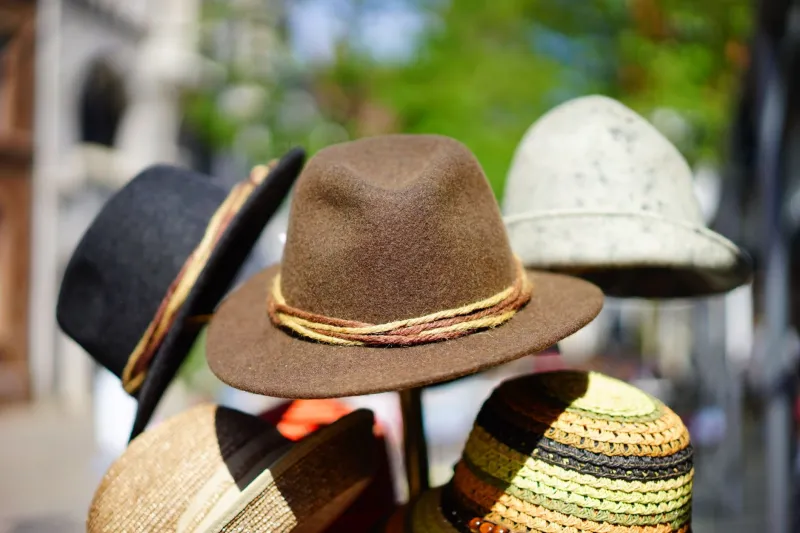
Proportion governs the choice. A hat sits in relation to the shoulder and the lapel, and its brim should answer to both. A fedora with a brim of five to six centimetres works on most frames and pairs naturally with a structured overcoat; a wider brim begins to dramatise, and should be reserved for the taller figure or the fuller coat. The tweed cap, by contrast, sits close to the skull and imposes almost no width at all, which makes it the most forgiving option and the one least likely to look like a decision. Between them lies the flat cap in wool or waxed cotton, and the soft felt with a modest downturn at the front.
The rule is simple enough to state and difficult enough to obey: the hat should not be the widest point of the silhouette, nor the narrowest. It should conclude the figure, not compete with it.
Felt, Tweed, Waxed Cotton: A Material Argument
Oxford's winter is rarely a downpour and almost always a dampness. This matters, because it argues for materials that hold their shape in moist air rather than surrendering to it.
Fur felt — rabbit or hare, blocked and stiffened — is the traditional answer. It resists light rain, accepts a brushing, and can be reblocked by a hatter when the crown softens. Wool felt is the cheaper cousin: warmer in appearance, quicker to lose its structure, and best treated as a seasonal rather than a lifelong purchase. Neither should be dried on a radiator, which is the surest way to shrink a crown and destroy a brim.
Tweed is the quieter choice, and the more English one. A herringbone or barleycorn cap in grey or brown sits comfortably with flannel trousers and a wool overcoat, and asks nothing of the wearer in the way of attitude. It is also the most practical hat for cycling or walking, which is to say for the way most people actually move through this city.
For the genuinely wet morning, a waxed cotton hat with a stitched brim — the sort sold by outfitters rather than fashion houses — does the work without pretension. What should be avoided is the technical shell, the hood, the waterproof cap in a fabric that rustles. A brim is a modest piece of engineering; it need not look like equipment.
The Brim and the Weather
A brim of five centimetres will keep drizzle off the face and spectacles; anything more is a matter of taste rather than function. The interaction with an umbrella deserves a word. A hat and an umbrella together are not redundant, but they require a certain discipline: the umbrella is carried low and behind the shoulder, not brandished above the crown, and the hat is angled rather than pressed down. In wind, the hat should fit well enough to stay without a chin strap; if it does not, it is the wrong size.
Colour, Texture and the Low Winter Light
In weak light, contrast reads more strongly than colour. A charcoal hat against a navy coat, or a dark brown against olive, will register before the coat itself does. This is not undesirable, provided the tones are related. Black is best reserved for formal wool and the darker city coats; a black hat above a brown tweed coat tends to look like an afterthought.
Texture is the more subtle instrument. A smooth felt with a flannel overcoat creates a pleasing difference; a tweed cap with a tweed coat risks looking like a suit of armour. The scarf should echo the hat rather than match it — a grey cap with a charcoal scarf, a brown felt with a muted olive — so that the eye reads a family rather than a uniform.
Etiquette, Quietly Observed
Manners in headwear have loosened, but they have not vanished. A hat is removed in a chapel, a dining room, a sitting room and a theatre; it is lifted, or at least touched, in greeting, particularly to those older than oneself. The elaborate hat-tip belongs to another century; a nod will do. In hallways and porters' lodges, the hat may remain on the head but should not be placed on a chair. The practical rule is the social one: a hat is worn outdoors and carried indoors, and carrying it well is part of wearing it well.
Buying and Keeping
Measure the head above the ears and across the brow; a hat should sit snugly without leaving a mark. Try it with the coat you will actually wear, since collar height changes the line. Prices in Oxford range from around eighty pounds for a wool felt to several hundred for a blocked fur felt; the difference is felt most in the third winter rather than the first. Brush with the nap, rest the hat on its crown rather than its brim, and rotate between two if the weather is persistent.
A hat is not a statement. It is the last line of a sentence that the coat began, and in a city of low light and long shadows, that line is worth finishing.