The Almost-Noticed Accent: Pocket Squares and the Discipline of Restraint
A pocket square is often called a finishing touch, but the phrase gives it too much air. It is better understood as a small act of private order: a square of linen, wool or silk folded at the breast, visible only in outline. In Oxford, where dress tends to speak in lowered tones, that is its proper role. The square should not announce the wearer before he has spoken. It should reward the second glance.
A Gesture, Not a Signal
The case for restraint begins with purpose. A pocket square is not a tie, a badge or a seasonal decoration. It is a domestic object carried into public: something pressed, folded and placed with care. Its value lies in that care rather than in conspicuous colour. When it reads as private habit—a small discipline observed before leaving the house—it sits naturally beside Oxford's tweeds, flannels and quiet overcoats. When it reads as performance, the effect is immediate and unfortunate. The breast pocket becomes a stage, and the wearer a man in fancy dress.
This distinction matters in a university city, where town and gown meet in rooms that are seldom designed for display. A lecture hall, a library, a college chapel and a solicitor's office all favour clothing that can be read slowly. The pocket square belongs to that register. It is the almost-noticed detail: present, considered, never insistent.
Linen, Wool and Silk: Three Registers of Cloth
Linen is the natural daytime choice. It has a dry, matte surface and a slight irregularity that keeps it from looking too polished. White and cream are the most useful, with pale blue a close third. A linen square should be folded loosely enough to retain some texture; pressed into a hard triangle, it loses the ease that makes it appropriate for morning.
Wool, including fine flannel or a lightweight challis, answers the colder months. It pairs well with tweed, heavy worsted and the grey flannel trousers that recur in an Oxford winter wardrobe. A wool square in muted olive, charcoal or deep burgundy adds depth without shine. It should be soft enough to fold and small enough to sit below the pocket line.
Silk is the evening register, but it requires discipline. A high-sheen silk square in daylight can look too eager, particularly beside a matte wool jacket. For evening, choose a silk with a dull finish, a small scale pattern or a solid colour. White silk is correct with dinner tailoring; a dark silk can work with a velvet jacket or a heavy overcoat, provided the fold remains narrow.
Folds for Daylight
The flat fold, often called the television fold, is the most discreet. The square is folded into a neat rectangle so that only a straight line of cloth shows above the pocket. It suggests order without effort and suits formal daytime engagements, interviews and any occasion where the jacket is doing enough talking on its own.
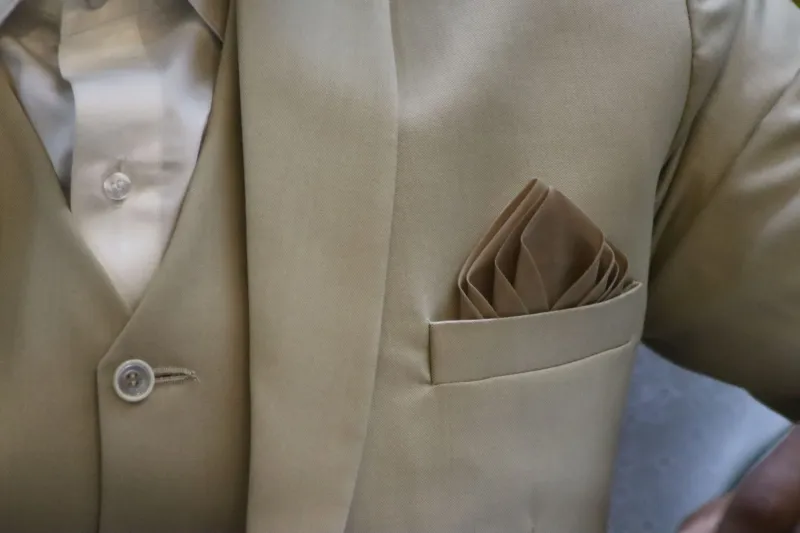
The single point is equally useful, but it should be soft rather than sharp. One peak of linen, slightly off-centre, is enough. Multiple points belong to another era and another temperament. The puff fold—loose, rounded, with no visible points—works well with linen and wool, especially in a textured jacket. It should look as though the square has been placed rather than sculpted.
Evening and the Narrow Line
After dark, the square should become quieter still. A narrow flat fold in white linen is the safest and most elegant choice with a dark suit or dinner jacket. If silk is used, keep the colour low and the finish restrained. Avoid the temptation to coordinate with a tie or a pocket watch; the square is not part of a matching set. It is a separate, private note.
Colour, Scale and Pairing
Scale matters more than pattern. A square of roughly 30 to 40 centimetres is ample for most folds; anything much larger becomes bulky in the pocket. The colour should relate to the jacket, shirt or overcoat rather than compete with them. A white square beside a grey jacket is rarely wrong. A muted burgundy or olive square can echo a scarf or a pair of gloves, but the echo should be faint.
Pairing is a matter of texture as much as colour. Linen with tweed, wool with flannel, silk with worsted or velvet: these are sensible affinities. Avoid a square that matches the tie exactly, and avoid one that introduces a colour absent from the rest of the outfit. The square should feel as if it belongs to the wardrobe, not as if it has been added at the last moment.
Avoiding the Costume Effect
The costume effect arrives through excess: too many points, too much shine, too bright a colour, too neat a match. It also arrives through novelty. A pocket square printed with a crest, a cartoon or a seasonal motif may have its place, but not in a wardrobe built on restraint. The safest rule is simple: if the square can be described before the wearer is seen, it is probably doing too much.
For 2026, the useful wardrobe might contain three squares: a white linen for daytime, a muted wool for winter, and a dark silk for evening. They need not be expensive. They need to be pressed, folded with a little care and worn without comment. That is the whole art of the almost-noticed: not invisibility, but a detail that waits to be found.