The Carried Middle: Dressing for Oxford’s Winter Thresholds

Oxford in November is not a single climate. It is a sequence of small climates, each one entered and left within minutes. A damp High Street gives way to an overheated college staircase; a cold Turl Street doorway opens onto a pub with the heating turned up for December; a bookshop on Broad Street is warm enough to make a wool coat feel like an error of judgement. Dressing for this is less about finding the warmest garment and more about managing the layer in the middle.
The Threshold Problem
The outer coat is rarely the difficulty. It is the layer beneath it that decides whether one arrives at a lecture, a lunch or a bookshop browsing session looking composed or merely overheated. A heavy jumper worn from morning to night becomes a burden indoors. A shirt alone is inadequate between buildings. The useful garment is the one that can be removed at the door, carried over an arm and put back on without appearing to have been slept in.
This is the shed layer: a middle piece with enough structure to be seen and enough lightness to be carried. It should not compete with the coat, nor should it behave like underwear. It is the layer that makes the transition from street to room feel deliberate rather than merely tolerated.
A Middle Layer That Earns Its Keep
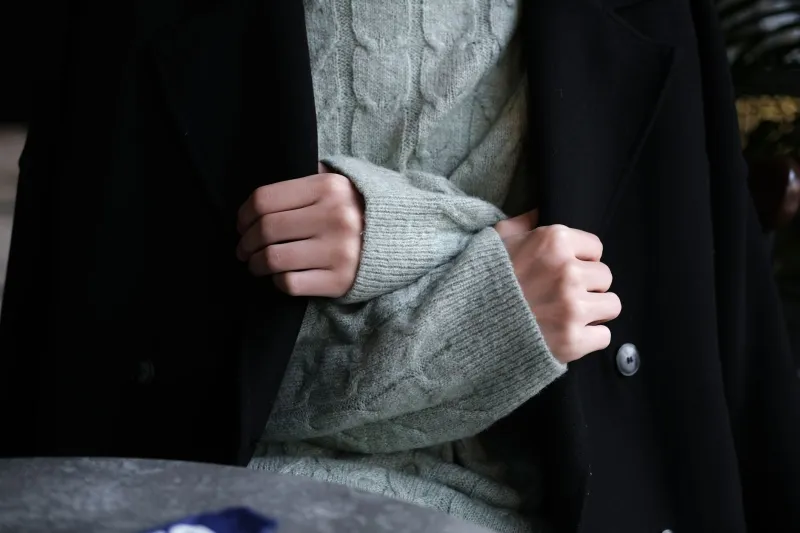
The most reliable version is a fine-gauge wool crew neck or a lightweight wool overshirt, chosen in a colour that sits quietly between shirt and coat. Mid-grey, navy, deep green and oatmeal are useful because they do not announce themselves when revealed indoors, and they do not look orphaned when carried over a dark coat. The fit should be close enough to sit under a jacket without bunching, but not so close that it resembles a base layer.
A knitted piece in a firm, tightly twisted yarn is preferable to a loose, fluffy one. It holds its shape when folded and does not shed fibres onto a dark coat. A wool-silk blend can be useful for rooms that are warm but not tropical; it feels lighter than lambswool and recovers well from being draped. Brushed wool is comfortable but should be reserved for days when the layer will stay on, as it can look tired after an hour over the back of a chair.
Fabrics That Forgive the Fold
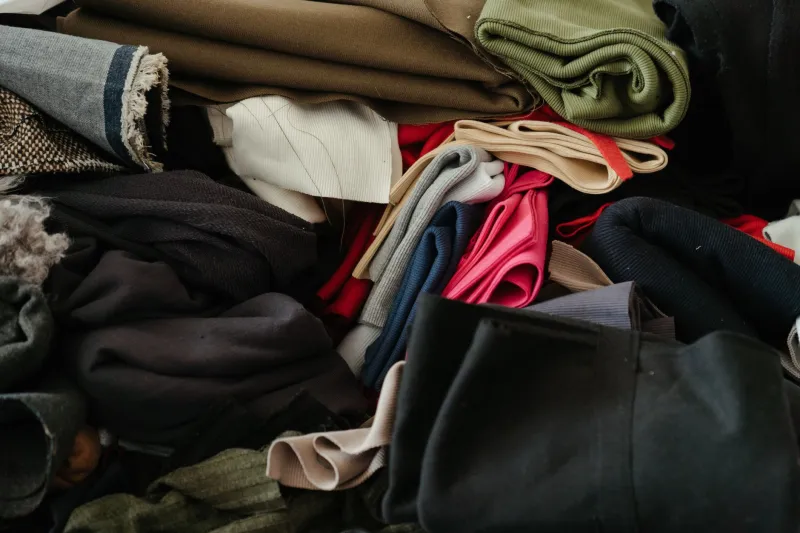
The test is not how the layer feels when first put on, but how it looks after being removed. Ribbed knits are dependable because the rib gives the garment a memory of its own shape. Flannel and felted wool can be smoothed back into order with a hand and a little steam, though they are better carried than crushed into a bag. Cotton twill and lightweight technical fabrics have their place, but they tend to show creases at the elbow and can look too casual beside a tailored coat.
Avoid anything that requires careful handling at the door. A layer that must be folded exactly, or hung immediately, will soon become a nuisance. The practical middle layer is one that can be folded once over the forearm, laid across a chair back or hung on a hook without ceremony. It should look acceptable in all three positions.
The Choreography of Arrival
Arriving well is a small social skill. In a college porch, the coat comes off first, then the middle layer is folded and carried rather than draped over the shoulders. In a pub, the layer should go to a hook or the back of a chair, not into a heap on the banquette. In a bookshop, it can rest over the forearm while one reaches for a shelf; the alternative is a layer over the basket, which rarely ends well. These are not rules of etiquette so much as ways of preventing the wardrobe from becoming a performance.
The point is to reduce friction. A man carrying a coat, a scarf, a bag and a folded jumper is not elegant, however well each piece is made. The middle layer should be the only additional object one has to manage, and it should be light enough to be forgotten until it is needed again.
Leaving Without the Litter of Layers
Departure has its own discipline. The middle layer goes on before the coat, not after, so that sleeves are not pushed up and collars are not crushed. If the room has been warm, it is better to carry the layer to the door and put it on outside than to overheat in the final minutes. A scarf can wait until the threshold. The coat should be buttoned in the porch, not on the pavement.
This small order of operations matters because it preserves the line of the coat and the shape of the layer beneath. It also avoids the common winter habit of arriving home with a jumper stretched at the neck and a coat that has been carried rather than worn.
A Small Discipline
Oxford’s winter asks for a wardrobe that can be edited in motion. The shed layer is not a dramatic piece, nor should it be. Its value lies in the quiet way it allows one to move between the damp street and the warm room without looking overburdened or underprepared. In a city of staircases, thresholds and short walks, that is a considerable virtue.