The Unseen Register: Hosiery and the Composure of the Oxford Ankle
November in Oxford does not announce itself so much as settle: a dampness in the stone, a sharper edge to the morning air, a tendency for the pavement to hold the cold long after the sun has cleared the spires. In such conditions, the wardrobe is tested less by its outer layers than by its small ones. The sock, in particular, becomes a register of intention. It is rarely seen for long, yet it governs comfort, preserves the shoe, and decides whether the line of a trouser is completed or interrupted.
At Jordell Oxford, the view is that refinement is often a matter of what is properly resolved below the surface. The ankle deserves that attention. It is the hinge between shoe and trouser, between the formal and the practical, and it is where the cold-weather wardrobe either holds its composure or quietly fails.
The hinge between shoe and trouser
The ankle is a working joint, not a display space. When a man sits, crosses his legs, or climbs the steps of a library, a small band of hosiery becomes visible. In that moment, the sock should read as continuity: a dark note beneath a flannel trouser, a fine rib beneath a worsted suit, a quiet texture that supports the shoe rather than competing with it. The aim is not to be noticed. The aim is to be correct.
This is why the sock should be chosen with the same logic as the lining of a jacket or the edge of a pocket square. It is an internal detail made briefly external. A fine merino in charcoal, a ribbed wool in dark navy, a near-black hose with black calf: these are not novelties. They are the small disciplines that allow the rest of the outfit to behave properly.
Fine merino and the cold morning
For the ordinary Oxford morning, fine merino is difficult to better. It regulates temperature without bulk, handles the damp with more composure than cotton, and sits smoothly inside a shoe. A fine-gauge merino in mid-grey or dark navy will serve beneath flannel trousers and a brogue, beneath a tweed suit and a derby, or beneath the more relaxed uniform of chinos and a lambswool crew. It is warm without being heavy, and it does not disturb the fit of the shoe.
The common error is to treat cold weather as a licence for thickness. A bulky sock in a close-fitting shoe will compress the foot, shorten the stride, and leave the leather strained at the vamp. Better to choose a fine wool and reserve the thicker rib for boots or for days when the walk is longer than the appointment. The shoe should remain the shape it was intended to be.
Rib as texture, not ornament
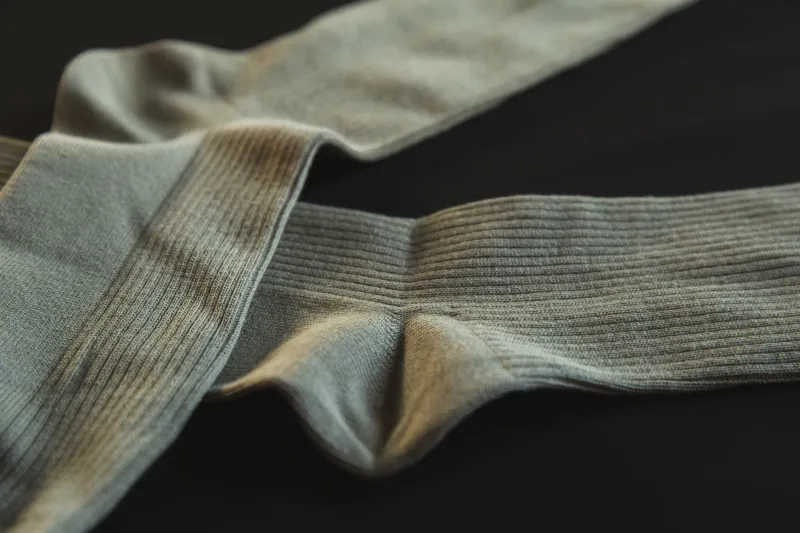
Ribbing is a practical structure before it is a decorative one. It gives stretch, holds shape, and allows the sock to grip the calf without cutting. In a fine wool, the rib is subtle: a faint vertical texture that catches the light when the ankle is exposed, then disappears again beneath the trouser. This is texture in the best Oxford sense, felt rather than announced.
A ribbed wool sock in a dark neutral is particularly useful in the transition months, when the morning is cold but the afternoon is not. It offers a little more substance than a plain fine gauge, yet it remains quiet. Avoid the temptation to introduce contrast clocks, bright stripes, or sporting motifs into a tailored context. These belong to another wardrobe altogether. With tailoring, the rib should be the only pattern, and even then it should be modest.
The darker hose with tailoring
The case for darker hose is simple: it extends the line. A dark sock beneath a dark trouser creates an unbroken column from knee to shoe, which is particularly useful when seated. A lighter sock can cut the leg visually and draw the eye downward, which is rarely the intention in a formal setting. This is not an absolute rule, but it is a reliable principle.
With a navy suit, choose a navy or charcoal sock. With grey flannel, a charcoal or mid-grey fine wool will do. With brown shoes, a dark brown or charcoal hose is often more harmonious than black, though black remains correct with black calf and formal evening dress. The point is to avoid the accidental contrast of a pale ankle beneath a dark trouser. That single error can make an otherwise considered outfit look unfinished.
Long walks and the practical order
Oxford is a walking city, and the cold-weather walk is part of its daily rhythm. The path from a college to a lecture hall, the towpath along the river, the damp cobbles behind the High: these are not extremes, but they are enough to expose a poor sock. A wool or wool-blend sock with a reinforced heel and toe will serve better than a soft cotton pair, which holds moisture and loses shape. The sock should stay in place, dry reasonably, and not bunch under the arch.
For longer walks, a ribbed wool in a boot sock is sensible, provided the boot has room for it. For the shoe, keep the gauge fine. It is also worth keeping a spare pair in the drawer for wet days. A small practical order, observed quietly, prevents the larger discomfort that can undo a day's composure.
Formal evenings and the discipline of restraint
For evening dress, the sock should disappear into the scheme. A fine dark wool, perhaps with a touch of silk in the blend if the shoe is particularly close-fitting, will provide a smooth surface and a sober line. The ankle should not become a site of costume. No clocks, no contrast heels, no visible branding. The discipline is to let the trouser break and the shoe do their work while the sock maintains the temperature and the line.
This is where the sock becomes an understatement rather than an affectation. It is not asked to perform. It is asked to be correct, warm, and unobtrusive. In a wardrobe that values restraint, that is a considerable role.
A small audit for the drawer
A workable drawer might contain four to six pairs of fine merino in dark neutrals for daily tailoring, two or three ribbed wool pairs for colder mornings, and one or two lighter pairs for milder days. Inspect the elastic and the heel regularly; a sock that has lost its shape will soon lose its purpose. Wash cool, dry flat or line dry, and pair them before they go back into the drawer. This is not indulgence. It is maintenance, and maintenance is part of the wardrobe's character.
The ankle is easily overlooked, which is precisely why it repays attention. In the Oxford wardrobe, comfort and refinement meet in that small, unseen register. A considered sock does not ask for notice. It simply keeps the whole arrangement in good order.